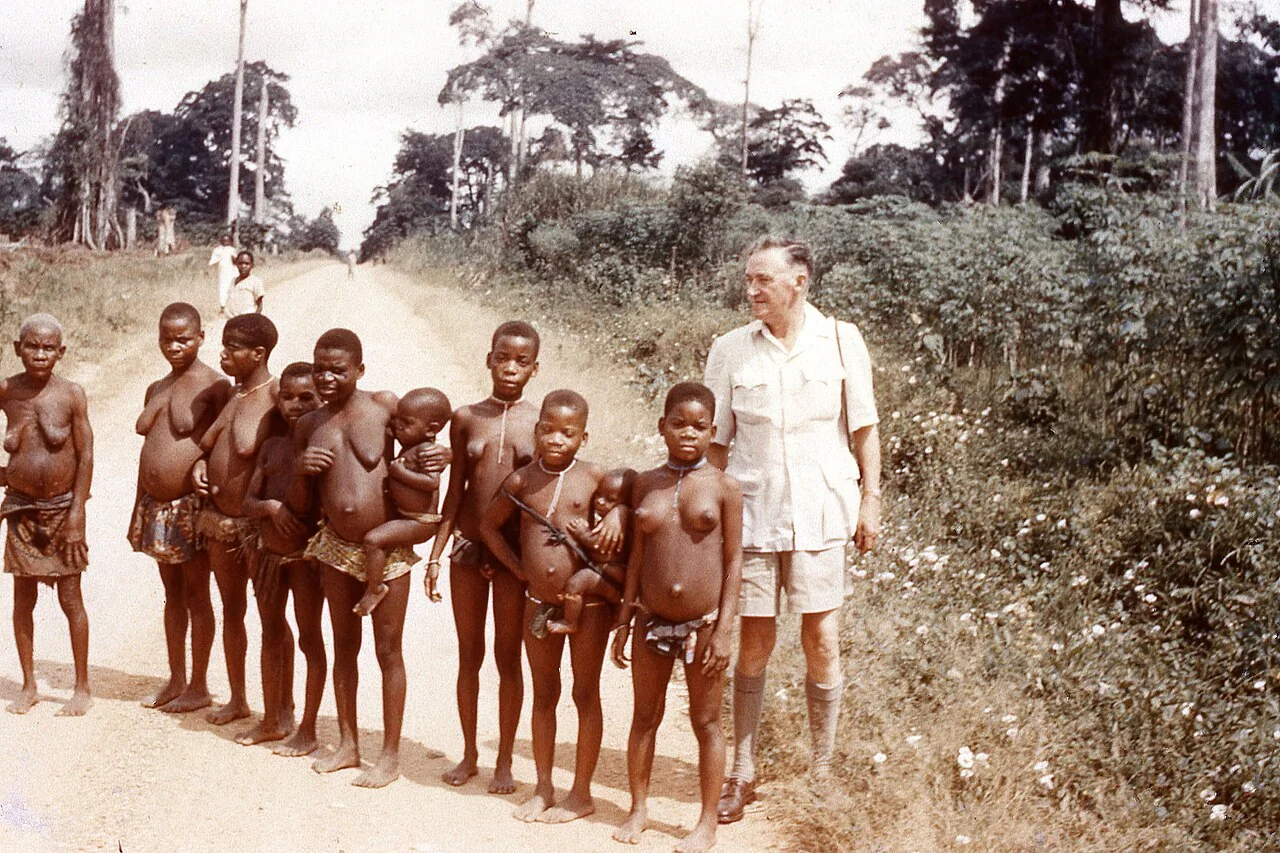
Mbuti (Bambuti) people of the Ituri forest photographed after crossing from Congo into Uganda Jitze Couperus · CC BY 2.0 · Web size optimized; source linked for the original.
In the dense Ituri Forest of Central Africa, Mbuti communities have long relied on cooperative net hunting as a primary way to secure daily food. Multiple field studies from the 20th century document how entire bands, including women and children, work together to flush and trap animals such as duikers. While popular accounts sometimes link quiet, scent-driven dogs to these hunts, the core research on net-hunting techniques does not describe their involvement. This article draws directly from the available ethnographic evidence to explore the method, its social organization, and its ecological setting, while noting what remains unconfirmed.
The Setting: Life Inside the Ituri Forest
The Ituri Forest stretches across northeastern Democratic Republic of Congo, a vast expanse of tropical rainforest that supports an extraordinary variety of wildlife. Mbuti groups, often called BaMbuti or Pygmy communities in older literature, have adapted to this environment over many generations. Researchers who lived among them observed that the forest supplies not only game but also materials for shelters, tools, and the very nets used in daily hunts. One study from the 1970s noted that net hunting forms the foundation of subsistence for certain bands, shaping their movements and social rhythms around the availability of prey.
Because the canopy is thick and visibility is limited, successful hunting depends on intimate knowledge of the terrain and animal behavior. Duikers, small antelopes that hide in undergrowth, are among the most commonly targeted species. The same research also records genets and mongooses as part of the catch. This reliance on a narrow range of medium and small mammals means that the hunters must be efficient; missing a drive can affect the band’s food supply for that day. The studies emphasize that net hunting is not a casual activity but a carefully repeated pattern woven into the community’s calendar.
Rainforest in Ituri (documentary photograph). MONUSCO Photos · CC BY-SA 2.0. Web size optimized; original linked.
How Net Hunting Works
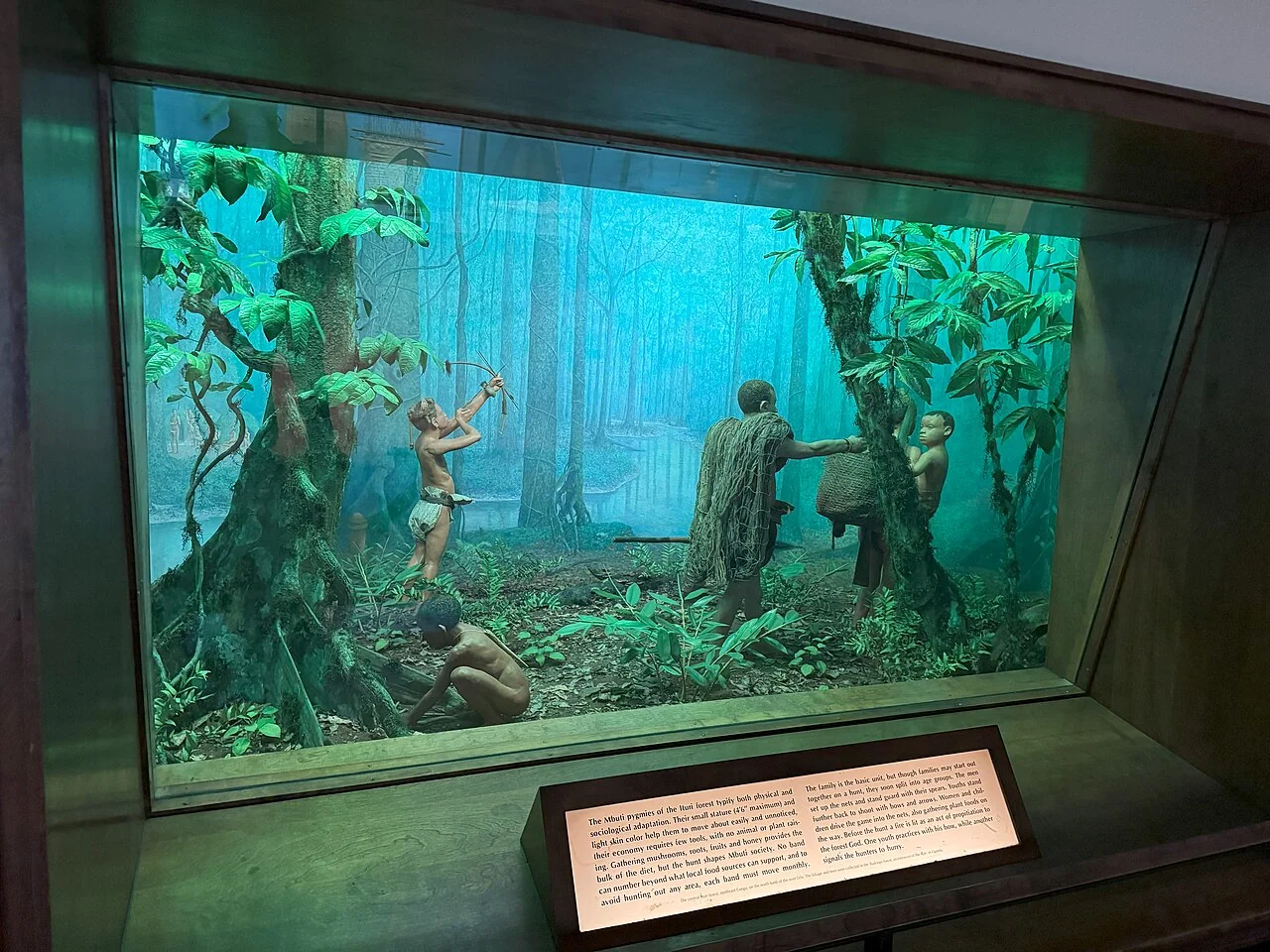
Mbuti net hunters stretch long, handmade nets between trees or bushes to form a barrier. A group of people, frequently including women acting as beaters, then move through the forest making noise to drive animals toward the nets. Once an animal is tangled, hunters quickly dispatch it. This method contrasts with bow-and-arrow hunting used by neighboring Mbuti groups, a distinction highlighted in fieldwork that compared the two strategies. The net system allows larger bands to participate together, turning the hunt into a collective effort rather than an individual pursuit.
Observers recorded that a typical net hunt requires coordination among perhaps a dozen or more adults and older children. The beaters must space themselves so that animals cannot easily slip past, while those minding the nets stay alert for sudden movements in the mesh. One researcher who spent time in the mid-1970s described how the forest’s thick vegetation makes this teamwork essential; without it, the prey would vanish into the understory. The studies do not mention the use of dogs in these drives, nor do they describe distinctive vocal calls beyond the general noise made by the beaters.
Social Roles and Band Composition
Net hunting is notably inclusive. Women routinely take part as beaters, contributing directly to the success of each drive. A comparative analysis of net-hunting and archery bands found that women’s labor in the net groups adds substantial caloric returns to the community. This participation influences meat-sharing patterns and even marriage arrangements, as the value of a woman’s hunting effort becomes part of social calculations. The evidence shows that band size and composition adjust to the demands of net hunting, with larger groups forming when conditions favor the method.
Men typically handle the final dispatch and carrying of game, but the studies stress that the hunt is a joint enterprise. Children learn the forest’s sounds and signs from an early age by joining these outings. One report from the late 1980s noted that the division of labor appears to give net-hunting bands a different subsistence profile than archer bands, though the underlying forest ecology remains similar. The researchers stopped short of claiming that one system is superior; instead they documented measurable differences in how labor translates into food and social prestige.
Mbuti women in Mabukulu village, Democratic Republic of Congo Garry Walsh / Trócaire · CC BY 2.0. Web size optimized; original linked.
Dogs in the Forest: What the Records Show
Travelers and naturalists who visited Mbuti camps in the early 20th century reported seeing small, barkless dogs that locals valued for tracking. One account from a 1909–1915 expedition describes these animals as keen of scent and relatively quiet while following game trails. The writer obtained a puppy from a Mbuti encampment and noted that hunters appreciated the dogs’ ability to help locate or round up small mammals, sometimes in combination with nets. However, the same observer explicitly stated that he never participated in or directly witnessed a hunt that used the dogs himself; his comments reflect what he was told and what he inferred from camp life.
Later ethnographic studies that focused specifically on net-hunting techniques make no reference to dogs. The 1970s fieldwork on band composition and the 1989 comparison of women’s roles both omit any mention of canine assistance. This silence does not prove the dogs were absent, but it does mean the detailed mechanical descriptions of net drives do not include them. Readers are left with an interesting gap: early anecdotal reports suggest the animals were prized, while systematic hunting studies concentrate on human coordination alone.
Implications and Open Questions
The available evidence paints a picture of a flexible, community-based hunting system finely tuned to the Ituri Forest’s challenges. It underscores the skill and cooperation required to turn dense vegetation into a productive pantry. At the same time, the limited overlap between dog anecdotes and net-hunting research invites caution. Claims that specific breeds routinely drive game into Mbuti nets rest on narrow, second-hand observations rather than replicated field records. This distinction matters for anyone interested in cultural knowledge or conservation, because overstating the role of dogs could misrepresent the primary labor that women and men perform.
What questions remain useful to ask? How do current Mbuti communities balance traditional net hunting with outside pressures such as logging or changing wildlife populations? Would renewed fieldwork that explicitly records the presence or absence of dogs during drives help close the gap between early traveler tales and later scientific studies? The evidence we have is valuable but partial; it reminds us that forest societies are dynamic, not frozen illustrations. Approaching them with curiosity rather than romantic assumptions preserves both accuracy and respect for the people who still navigate the Ituri’s green labyrinth.
Mbuti men on a hunt in the Ituri forest - the diorama at American Museum of Natural History Vicpeters · CC BY 4.0. Web size optimized; original linked.
AI-assisted original writing. This feature was revised against source material and checked for unsupported claims. Follow the references below for evidence and its limits.
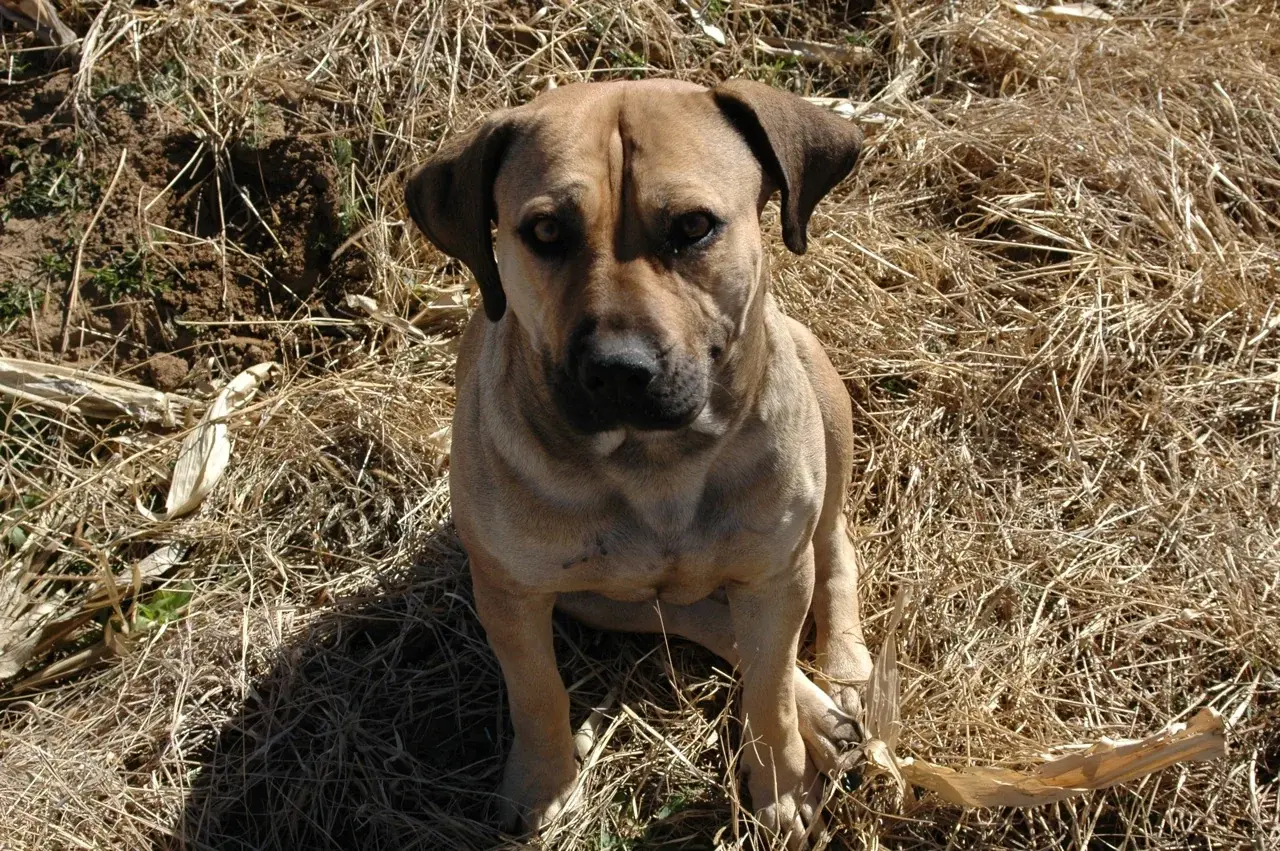
Large mastiff-type dogs have served as protectors on remote South African farms for generations, though many popular stories about their exact origins remain unverified tradition.


 Photograph